The Child
Attatchment
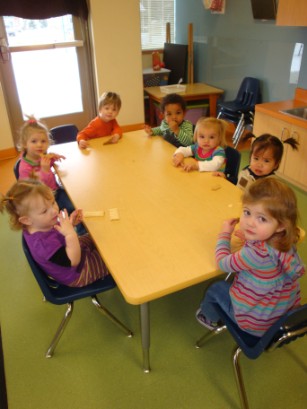
This is an important part of relationships for young children. They need to feel close and connected to other people in order to be comfortable in their world.
How the brain develops has to do with the genes and experiences children have in their life. Early involvement and interactions can enhance how children develop and grow. (Eyer and Gonzalez-Mena, 2012). We take this research seriously and strive to provide the best developmental interactions that benefit your child's brain growth.
Infants are wired to form attachments with adults by establishing eye contact, bonding through touch, and following and responding to their voice. These important interactions start to form a trust between the child and adult. Many routines and activities throughout the day promot this bonding experience: feedings, diaperings, meals, and various other activities throughout the day. These positive interactions and experiences help the brain develop. From birth to 12 weeks children are experiencing the first part of attachment. Crying, watching, and grasping for those around them help to form a bond between adults and children. 10 weeks to 6-8 months children are now noticing certain people in their life and act certain ways with them and trust is developing. Strangers may cause uneasiness and a change in mood. From 8 months to 18-24 months children begin to show separation anxiety, which is where the child becomes upset when a person they are attached to leaves them. They show physical responses to try and keep the people they are attached to close to them. They are also learning to slowly explore the world around them while always referring back to the person they are close to. From 24 months on children start to understand that adults they are attached to leave and come back. They become more able to separate and are comforted by words that let them know the adult will be back and when they will see them again. (Eyer and Gonzalez-Mena, 2012). Our staff understands the development journey of attachment and work to gain your child's trust and support.
Developmental delays and problems in some infants and toddlers may cause attachment concerns among parents. Giving informative and correct support for these needs will ensure that their needs are being met and goals are being made for secure attachments. We want your child to grow and develop to their full potential and experience healthy attachments, which is why we offer early intervention with an array of support from other resources and specialists in the area. We also have an onsite special education teacher that assists families in long-term developmental goals for their children.
.
Perception
Children learn about their world through their five senses. Children listen to adults speak and learn to mimic their sounds. They enjoy conversations and when you give them a chance to talk. They are responsive to different sounds and patterns and can distinguish one language from another. (Eyer and Gonzalez-Mena, 2012). Our center offers a wide range of listening activities from music classes to "talking time", where we teach the importance of sharing a conversation.
Children have a very distinct sense of smell and taste from the time they are very young. They can even recognize the smell of their own mother. Offering a wide range of smells and tastes can help toddlers develop these senses. Our center offers fun cooking projects and we invite the children to try new tastes and smells. Our children are also introduced to new snacks once a month to add interest and fun!
"Sensitivity, or responsiveness to discomfort and pain, increase rapidly after birth." (Eyer and Gonzalez-Mena, p. 121) Some children liked to be touched more than others. Our teachers understand that some children are more sensitive than others and may need special adaptions made to make them more comfortable in their surroundings. Children learn to move around to explore their world. They thrive on an environment that can be touched and moved. Our classroom's environment includes plush and comfortable couches and pillows, textured walls to feel and explore, soft mats to roll around on, and an array of hard and soft surfaces to discover. Our art time is also a great way to explore with our senses. We paint, mold with play dough, and explore with sand and water. All of these activities introduce new feelings that we can define!
Did you know that within a few weeks, infants enjoy warm colors (reds, yellows, pinks) to cold colors (blues and greens)? And by 4 months of age, they nearly have 20/20 vision! (Eyer and Gonzalez-Mana, 2012 p. 124). Our classrooms create a calm, peaceful visual effect and the perfect amount of stimulation to help children focus and learn. Artwork is displayed at their level and the classrooms are designed to flow to make the children feel more comfortable. Quiet and Loud sections in the rooms are separated to limit distractions. In the "Quiet Areas" children can relax, read, and do quiet work. "Loud Areas" are used for our large motor activities.
Motor Skills
Encouraging motor Development is very important on a daily basis! Children learn to move and coordinate their body as it grows and changes. The body develops from head on downward and from the middle outward.
Brain research has given us a lot of information about motor development:
- Movement develops through our surroundings and experience as well as from our genetics starting st six weeks gestation.
- Coordination and strong muscles come with more neural connections and experiences.
- Fine motor skills are developed by an increase in myelinization (Eyer and Gonzalez-Mena, p.137-8)
Reflexes in infants are unlearned responses the muscles make when introduced to certain stimuli. These reflexes serve functions that are all important for babies to live and function. Blinking, swallowing, and breathing are all there to protect the infant. Kicking legs can help a child later on, when they are learning to walk. Each has a different function that help the child survive in their world.
Large motor skills help the child move around from one place to another. Moving legs and arms, crawling, walking and running are all large motor skills. Our caregivers encourage the practice of these skills on a daily basis. We schedule designated large motor time where the children can stretch out and practice these skills. Our classrooms also have an area that promotes the use of large motor skills where the child is welcome at any time.
Small motor skills help the child manipulate the world around them. They learn to grasp, hold, carry and even move objects. Our classrooms are filled with toys that promote the development of these small motor skills. We also introduce spoons to encourage feeding themselves. Even our art supplies promote these skills as the child learns to grasp the object and move and manipulate it.
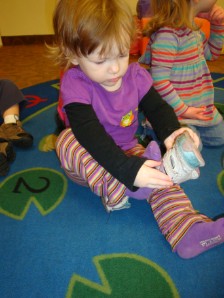
Self-Help Skills: Putting Shoes On
|  |
Cognitive
Children learn and understand their world by engaging themselves with people and things around them. As they watch people and things and manipulate them, they begin to realize how things work. Children begin life by responding to simple things like looking for a familiar person who has stepped away or getting things to happen. As they get older, they manipulate their world and move things the way they want to. By the time they are toddlers, they can do many things themselves, including dress, feed, and even communicate with other children and adults.
Two major theorists of development are Jean Piaget and Lev Vygotsky.
Piaget believed that a child’s knowledge was gained through self-learned activities and scenarios, such as hands-on, and play that promots sensory activities. Children's development leads to their learning.
Vygotsky believed in the importance of co-constructed learning and how trusted adults are a crucial part in the child’s development. When children have trust in an adult, they are better able to learn. Vygotsky called learning alongside another adult “assisted learning” because to set the stage to learn language and problem-solving skills the child needs that social contact with the adult. (Eyer and Gonzalez-Mena, 2012).
Language
How a child learns to talk starts with early interactions with adults and peers. Infants communicate to us through crying to get their wants and needs met. They also observe and imitate adults which starts the process of how they learn a language. It is very important to allow young children to "talk" even when they are not saying anything.
From birth to one year Receptive language is when they are ingesting and observing their world. They are listening, watching, and trying to understand it all. Expressive language starts during the first year until they begin to talk. It is a time when they improve their language to better communicate to others.
When children learn to talk, they can better communicate their wants and needs along with being able to give things names. They enter a world of symbols and meanings.
The brain influences language development right away through neural connections. Sounds that children hear on a regular basis are "mapped" in the brain.
To improve language growth, our staff provide many interactions that give children the opportunity to learn the language. Talking alongside a child makes them feel equal and accepted and it lets them enjoy the process of understanding how to converse. We give children plenty of time to talk to us. We also use and repeat vocabulary words that are learned daily. A great way to encourage language development is also through songs! We find the best way to teach a child a new concept or word is by singing along with them.
Learning a new language can be more of a challenge for some children. Success starts with the support of the child's family along with our many resources. We will work with you to design a path that meets your needs as a family. Take a tour of our center and ask about the wide variety of resources to help your child succeed.
Emotions
Emotions in infants improve as they begin to develop. At an early age they can laugh and show discust with an unfamiliar person. They soon begin to show pride in their accomplishments and become more independent and comfortable with themselves. By three years of age, children have mood swings, fears, and can express their own feelings toward others. (Eyer and Gonzalez-Mena, 2012).
Caregivers need to understand and be aware of different temperaments and behavior styles. Our staff help children adapt and manage their feelings in a way that supports their emotional development! Our emotion finder activity encourages children to know and understand how they feel and how they should handle them. Emotions of all kinds are accepted and welcomed and we encourage emotional identity. Helping children cope with fear and anger give them a better understanding of themselves. We also offer many self-calming skills that comfort a child when they are distressed. We offer calming items and even designate a small corner of the room for quiet time.
We believe that all children's primary needs must be met before a child can be comfortable and learn. We pride ourselves in strong, trusting relationships between the children and our caregivers.
Our school embraces and understands the importance of early intervention in emotional disorders. We understand and appreciate the uniqueness of your child and will work with you to help them develope and learn. Stop by our center and learn more!
Social Skills
Social skills begin with the attatchment and the relationships that come with that. They enjoy being with adults and want to play with them. They love spending time with adults and embrace the attention they get from them. They show interest in interacting with their peers and exploring objects and toys alongside eachother.
Erik Erikson was a theorist who studied social development. At every stage in a person's life, there were social conflicts between individuals and the process of resolving the conflicts. After the conflicts were resolved, the child moved onto the next stage. The frist two stages in infants and toddlers are:
- Trust versus Mistrust: Needs being met means children trust the world around them
- Autonomy versus shame and doubt: Children become independent and help themselves.
Our school makes sure your child's needs are being met in all areas. We learn to understand the things they want and need emotionally, socially, physically, and cognitively. We make sure their learning experience is comfortable and welcomeing. Independence is also a large part of your child's learning experience. We want to make sure they know and understand how to help themselves.
Separation
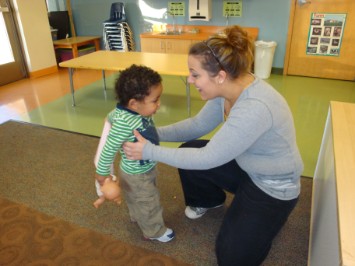
It is important that children feel comfortable with us. The parting process between child and parent can be hard. We encourage you to talk to your child about what you are doing and where you are going. Our stall also talks to your child about the events that are happening. We welcome comfort items to make sure the child is comfortable, as long as they are not a distraction to the rest of the class. It is hard to walk away from your child when they are upset. That is why we encourage you to call throughout the day to check up on your child and see how they are doing. Separation is an important skill that all children must learn. We are here and willing to work with you and your child.
Guidance
For infants, it is important that they feel secure and in control of their environment. We try to give them these comforts with responsive care. Toddlers have a need for limits, which also gives them a sense of security. Our staff provide these limits in a positive way. The verbal direction is given in a positive way, so the toddler knows what they should be doing, not what they cannot do. Our atmosphere is also set up to encourage positive behavior and limits.
Prosocial Behavior
To encourage positive behavior, we offer many activities that teaches children how to help themselves. We have daily routines that make them feel comfortable. We also encourage interests and ideas of the children by planning activities around their interests. This makes them feel accepted and appreciated. When conflicts do arise, we are there alongside the children, giving them the words to say to help them solve problems.
Promote Brain Growth
- We want to encourage healthy development through respecting children's feelings.
- Enforcing rules and limits gives the child consistency.
- Focusing young children's attention helps them center in on their environment.